Why India’s Alcohol Market Isn’t Really One Market
A bottle can be easy to find in Gurugram, unavailable in Delhi and significantly more expensive in Mumbai. That isn’t just a quirk of Indian retail. It’s what happens when one country operates through multiple state-level alcohol markets.
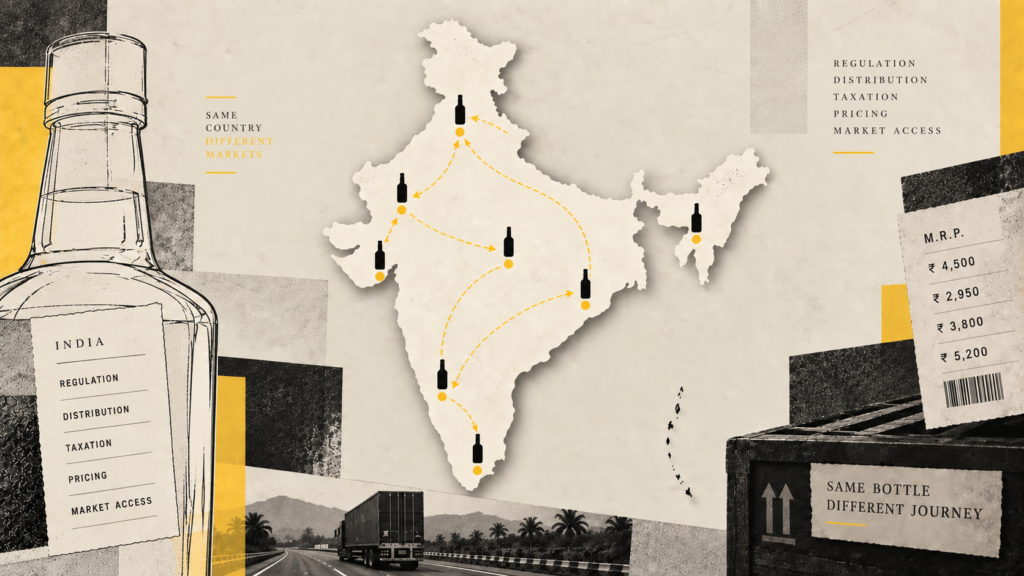
Whenever a new spirit is launched in India. Someone finds it in Goa almost immediately, another person spots it in Bengaluru, but there’s no sign of it in Delhi. When it eventually appears elsewhere, the price can be surprisingly different.
Same brand, Same bottle, Same country — but NOT really the Same market.
This is one of the peculiar things about following alcohol launches in India. When a brand says it has “launched in India”, that can mean anything from a genuinely wide rollout to being available in only a handful of states.
That’s because alcohol doesn’t operate like one straightforward national consumer market here. States and Union Territories have substantial control over how alcohol is registered, taxed, distributed and sold within their borders. The rules, costs and route to the consumer can change when a bottle crosses from one jurisdiction into another.
There is a fundamental reason for some of this fragmentation: alcoholic liquor for human consumption sits outside India’s GST framework. Unlike most consumer goods operating within a national GST system, potable alcohol remains heavily shaped by state taxation and excise regulation.
A national launch isn’t necessarily a “NATIONAL” launch
For a producer trying to sell a new liquor across India, there isn’t one registration that simply opens the entire country.
Goa requires liquor labels to be registered or renewed for its market. Delhi operates its own wholesale licensing, brand-registration and SKU system. Haryana’s current 2025–27 excise policy has its own brand-label approvals and fees. Maharashtra separately requires products coming from other Indian states to pass through its registration process.
So getting approval to sell a bottle in one state doesn’t automatically put it on shelves in another. And those registrations can carry meaningful costs.
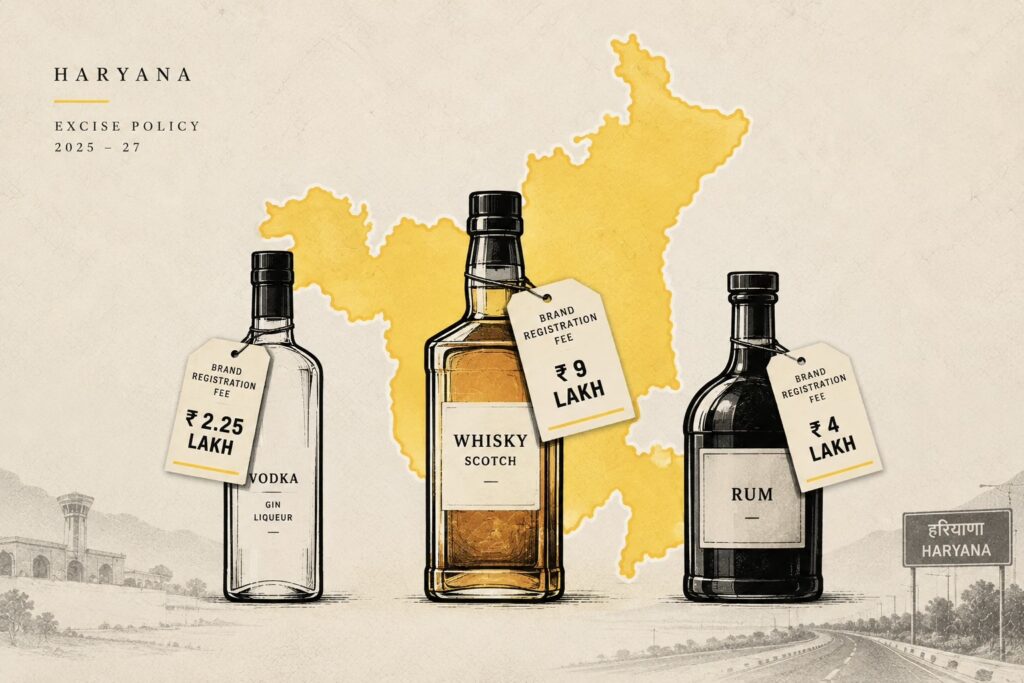
Under Haryana’s current 2025–27 excise policy, the fee for registering a whisky or Scotch brand label is ₹9 lakh. The corresponding fee for gin, vodka or liqueur is ₹2.25 lakh, while rum is ₹4 lakh — meaning even within the same state, the cost of registering a brand can vary considerably by category.
There is some relief for smaller launches. A new brand expected to sell no more than 1,000 cases during the policy period can initially register at 50% of the applicable brand-label fee, with the balance becoming payable if it crosses that threshold.
For a producer with several expressions, that creates a commercial decision: register the entire range in every market, or begin with the bottles most likely to generate enough sales?
That’s one reason a whisky brand might have five expressions available in one market and only its flagship somewhere else.
Cross a state border and the route to the shelf can change
Delhi and Gurugram make this fragmentation unusually easy to see because geographically they’re part of the same urban region. From an alcohol-business perspective, however, they sit inside two different systems.
In Haryana, private operators compete through e-tendering for retail liquor zones, with L-2 licences covering retail vends for Indian Made Foreign Liquor.
Cross into Delhi and the structure changes. The Delhi Excise Department says retail liquor trade is mainly in the hands of government undertakings, with L-6 licences granted to selected Delhi government corporations for retail vends of Indian liquor and beer. Wholesale supply operates separately through L-1 and L-1F licences.
So a brand that has established distribution in Gurugram hasn’t automatically solved Delhi. The registrations, licences and route through which that bottle reaches the shelf change across the border.
Maharashtra adds another revealing example. Its official label-registration system actually describes alcohol arriving from another Indian state as a “Domestic Import”, while products moving from Maharashtra to another state fall under “Domestic Export.”
Maharashtra also operates its own retail-licensing framework. Its FL-II licence covers retail sale of foreign liquor, and the State Excise Department currently states that new FL-II licences are not being granted.
These differences are why alcohol distribution in India isn’t simply about appointing one national distributor and sending bottles around the country. The route to market itself changes depending on where those bottles are going.
And yes, the price can change dramatically too
This is probably the part consumers notice most.
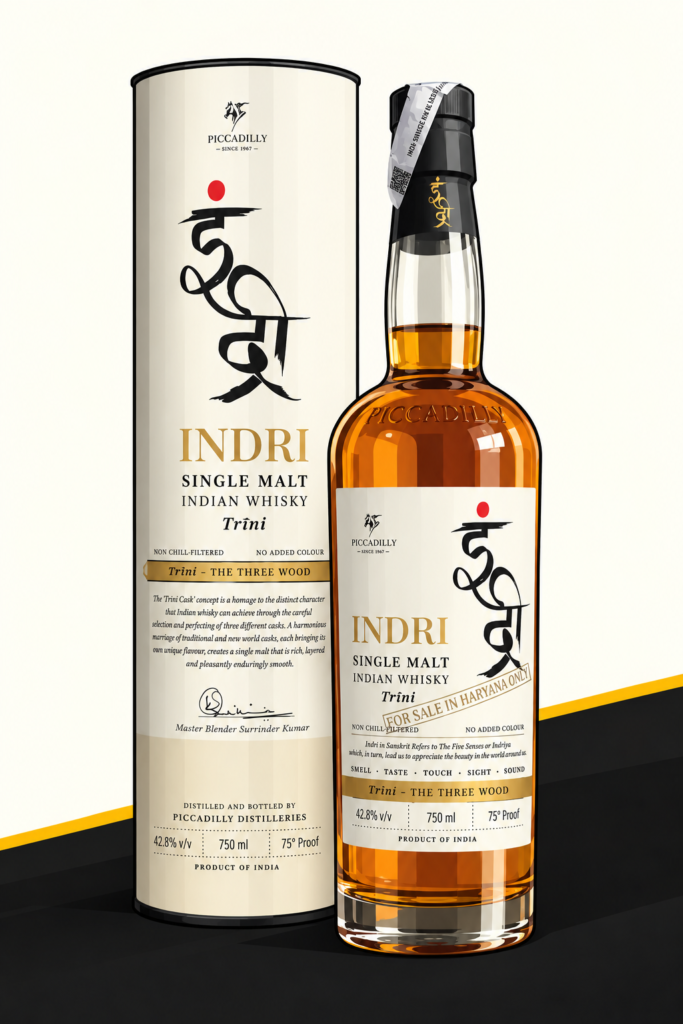
Take Indri-Trini, for example. Current price listings put a 750ml bottle at approximately ₹3,200 in Gurugram, ₹3,600 in Bengaluru, ₹3,700 in Delhi and close to ₹5,900 in Mumbai.
The liquid doesn’t suddenly become different when it reaches Mumbai.
The market around it does.
State excise duties, fees, pricing structures and distribution arrangements can all influence what eventually appears on the price tag. And those systems aren’t static.
Karnataka demonstrated that in May 2026 when it implemented a new Alcohol-in-Beverage excise structure. The reform linked part of the duty system to alcohol content, rationalised additional excise-duty price slabs and changed the way producers declare prices electronically through the state’s excise system.
One state can therefore materially change the economics of its alcohol market without the rest of India changing with it.
The fragmentation can even make it onto the bottle
You’ve probably seen alcohol labels carrying wording such as “For sale in Goa only” or another state-specific declaration.
That isn’t packaging trivia.
Goa’s Excise Department says liquor labels include information such as the MRP and whether a product is intended for sale in Goa or for export. Maharashtra separately requires labels intended for its market to be registered.
So even bottles containing the same spirit and carrying essentially the same branding can require different regulatory information depending on where they’re going to be sold.
The bottle itself can effectively tell you which market it belongs to.
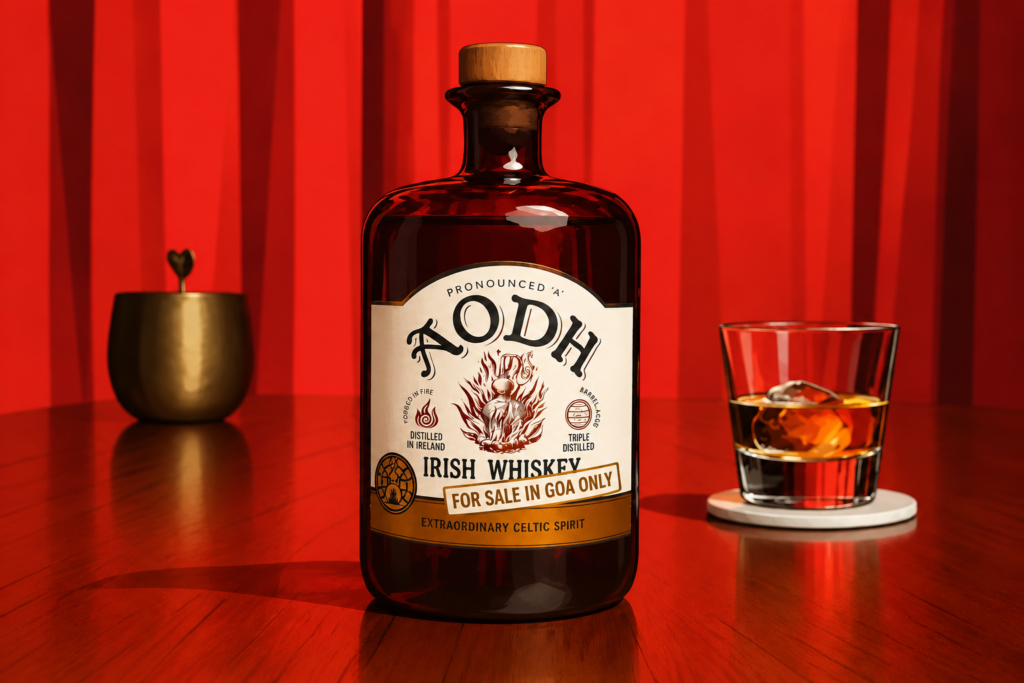
Which helps explain why some bottles never reach your city
Price gets most of the attention because it’s immediately visible, but availability tells us just as much.
A whisky might be widely available in Gurugram but difficult to find in Delhi, while another brand may launch in Goa, Haryana and Karnataka before reaching Maharashtra.
That doesn’t necessarily mean somebody has failed to distribute it properly. The brand may not yet be registered in that state, the right wholesale or distribution arrangement may not be in place, or the expected sales may not justify the cost of entering the market yet.
The same calculation applies to individual expressions. A producer with a flagship whisky and several smaller releases may decide that registering every bottle in every state doesn’t make commercial sense. The flagship goes first; limited editions and experimental releases remain in selected markets.
So what appears on a liquor-store shelf isn’t purely a reflection of what drinkers in that city want. It’s also a reflection of what makes commercial sense to put there.
The system is changing, but the fragmentation isn’t disappearing
There has been plenty of modernisation. Goa uses its GEMS platform for label registration, Delhi handles brand and SKU processes through eAbkari, and Karnataka’s 2026 reforms introduced electronic price declarations alongside broader changes to its excise system.
Digitisation can make individual systems easier to navigate, but it doesn’t make them the same system.
That distinction matters when we talk about “the Indian alcohol market”. There are national producers, national consumer trends and national category shifts, so looking at India collectively is obviously useful. But the phrase can hide a considerable amount of complexity underneath.
A whisky selling strongly in Bengaluru doesn’t automatically tell us how it is performing in Delhi. A bottle available in Gurugram doesn’t mean it is available across NCR. A price that works in one state can look completely different in another. And a brand announcing its arrival in India may still be months away from reaching large parts of the country.
India is one consumer market in plenty of ways.
Alcohol is one of the places where that idea starts to break down.
So the next time a brand announces that it has “launched in India,” there’s one very Indian follow-up question worth asking:
Which India?
Keep reading
Frequently asked questions
Why is alcohol regulated differently by different states in India?
Because India’s constitutional framework gives states significant powers over alcoholic liquor for human consumption, including state excise duties and taxes on its sale. Alcoholic liquor for human consumption also sits outside GST, so the national GST system hasn’t replaced these state-level tax and excise structures. The result is that states can operate very different systems for registration, licensing, distribution and taxation.
Does a liquor brand need separate approval in every Indian state?
There isn’t one national liquor registration that automatically gives a brand access to every state. The exact requirements vary, but brands generally have to comply with the registration, label, licensing and distribution requirements of each market they enter.
Can the same bottle of whisky legally have different prices in different Indian states?
Yes. Take Johnnie Walker Black Label: a 750ml bottle is currently listed at roughly ₹2,500 in Gurugram, ₹3,290 in Delhi and ₹4,250 in Mumbai. The whisky is the same, but state excise duties, fees, pricing rules and distribution structures can make the final price very different.
Does India’s fragmented alcohol market make it harder for smaller brands to expand?
It can. Entering additional states can mean more registration fees, approvals and distribution costs, which can weigh more heavily on brands with smaller sales volumes. That can encourage smaller producers to focus on selected markets rather than trying to build nationwide availability immediately.
Why do some alcohol bottles say “For sale in Goa only” or carry another state-specific label?
Because alcohol labels can form part of a state’s regulatory approval system. Goa, for example, requires approved labels to identify whether a product is for sale in Goa or intended for export, alongside information such as the MRP, strength and quantity. Its excise rules specifically provide for labels carrying wording such as “For sale in Goa” or “For sale in any other State”. So state-specific wording can indicate the regulatory market for which that bottle was approved.
Does buying alcohol in another state mean you can freely bring it home?
Not necessarily. Buying a bottle legally in one state and transporting liquor across a state border are separate issues. States can regulate the possession, import and transport of alcohol, and applicable limits or permit requirements can differ by jurisdiction. So a bottle being cheaper or available in a neighbouring state doesn’t automatically mean an unlimited quantity can legally be carried back.